August 1944
The division’s medical journal during the rapid advance across France, recording operations, casualties, evacuation, hospitals, medical supply, and the strain placed on medical personnel.
4th Armored Division · Historical context
These journals do not follow Kenneth or Company B directly. They record the wider division’s combat conditions, casualties, evacuation system, hospitals, medical supply, and the work of its medical personnel during August and September 1944.
Complete documents
Each file preserves the complete scanned journal and adds a hidden OCR text layer so names, dates, places, and terms can be searched or copied more easily.
The division’s medical journal during the rapid advance across France, recording operations, casualties, evacuation, hospitals, medical supply, and the strain placed on medical personnel.
The division-level medical record for the month of Kenneth’s death, including the increasingly severe fighting and casualty burden in the final third of September.
Near the time of Kenneth’s death
The September journal page places the division in sustained, violent combat. This excerpt is reproduced because Kenneth died of wounds on 24 September, but it must not be read as a direct account of his injury.
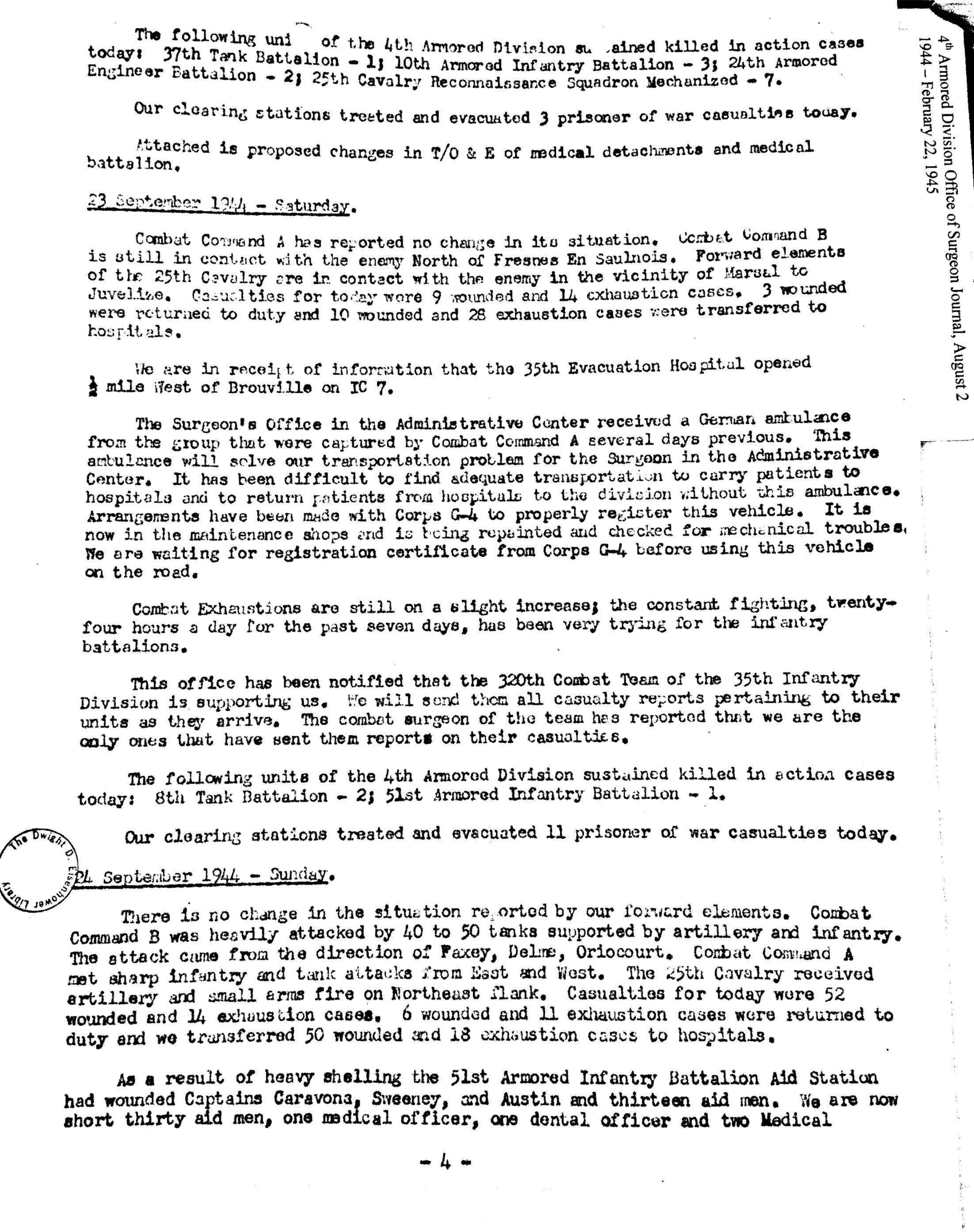
Combat Command A reported no change in its situation. Combat Command B remained in contact with the enemy north of Fresnes-en-Saulnois, while forward elements of the 25th Cavalry were in contact near Marsal and Juvelize. The journal recorded seven wounded and fourteen combat-exhaustion cases for the day.
Combat Command B was heavily attacked by forty to fifty tanks supported by artillery and infantry. Combat Command A met sharp infantry and tank attacks from the east and west, and the 25th Cavalry received artillery and small-arms fire on its northeastern flank. The journal recorded fifty-two wounded and fourteen combat-exhaustion cases. It also states that heavy shelling struck the 51st Armored Infantry Battalion aid station, wounding officers and aid men.